Monday, May 7, 2012

What is Tapestry Anyway?

Up to now, I assumed that most of my readers were fellow tapestry weavers. Perhaps not, since I give out my cards to lots of random people. So in case you were wondering….

Tapestry is a weaving technique that creates an image or pattern by using discontinuous weft.

Discontinuous what?

The WARP is the yarn that is attached to the loom and kept under tension; in this case, it’s the white cotton that runs vertically. The WEFT is the yarn that weaves under and over the warp threads to create the fabric.frameweavingIn the photo above you can see that there are 3 different colors of weft, and each color weaves back and forth just in the area where it is needed to create the design; that is what “discontinuous weft” means.  (In most fabric weaving, one piece of weft travels continuously from selvedge to selvedge.)

RedscarfIn most tapestries, the weft is packed down tightly, covering the warp completely, so the design is made just by the weft.

That’s different from most clothing fabrics, where you can see both the warp and the weft. These are 2 different scarves that I wove a few years ago.

FabricI like to use different colors in the warp and the weft, to create beautiful color blends.

Pretty simple, right? Actually it takes a lot of practice to be able to weave even a simple tapestry like the one above.

What about tapestry designs that are a lot more complex?

UnicornInCaptivityWeb2The photo on the right is The Unicorn in Captivity, a recently woven recreation, at Stirling Castle in Scotland. 

The original was woven around 1500, and hangs in the Cloisters, in New York City. 

For more about the Hunt of the Unicorn tapestries, and the project at Stirling Castle, see my previous blogpost  here.

For more information about tapestry weaving check out the American Tapestry Alliance website.

Wednesday, May 2, 2012

April Tapestry Diary

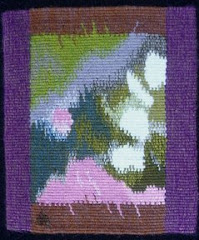
April was supposed to be yellow, but I couldn’t resist adding some light green too.

I was away for a week in early April, taking care of my 6 month old grandson, Silas. So when I came home, it was obvious what I had to do to fill up those days! I love designing and weaving text.

AprilMonthWhile I was away I visited the Textile Museum in Washington DC, and saw a wonderful tapestry by Archie Brennan (see the previous post), which inspired me to try different patterns in April. I am still thinking about ways to include small bits of color in my black and white tapestries, so this is good research.

I did tiny thin stripes, and one pick spots, and pick and pick spots for fatter dots, and color blends with dots, and dots created by alternating 3 colors of weft.

AprilDiaryThe dark shape on the top row, and the one just like it, one row down from the top, on the right, is dark gray wool mixed on the bobbin with a black and white cotton for the background.

Then there are small and bigger dots of light green, at irregular intervals, also mixed with the black and white cotton, and some dots that are pure green. I like the subtle, variegated effect. You can click on the photos to see them bigger.

What to do with May? I guess I’ll find out tomorrow…..I was too busy to weave it today, and now it’s almost midnight and I’m too tired.

AprilDiaryDetailDid I mention I have color-graphemic synesthesia? That means I associate certain colors with letters and numbers. It was much clearer to me when I was 5 or 6 years old, but there are still certain letters and numbers that are very clearly one color.

May could be green, because the letter M is green, but then I already did green for March; probably for the same reason. I was thinking about how I will weave the number 5 on the first day of May, then realized that May could be blue, because the number 5 is definitely blue (just like the letter S; must be something about that shape).

Anyway, blue and green will do nicely, and I can practice weaving the sea….I’ve been thinking about that lately.

Wednesday, April 25, 2012

Sourcing the Museum

at the Textile Museum, Washington DC
March 23 through August 19, 2012

“Museum  <Greek mouseion, temple of the muses…”

Jack Lenor Larsen invited 11 artists to each choose a piece (or pieces) from the museum’s collection, to use as their muse while creating a new, contemporary textile. The new pieces are displayed next to their muses, to (as the exhibit guide says) “reflect the connections between past and present.”

The artists are Olga de Amaral, James Bassler, Polly Barton, Archie Brennan, Lia Cook, Helena Hernmarck, Ayako Nikamoto, Jon Eric Riis, Warren Seelig, Kay Sekimachi, and Ethel Stein.

As a tapestry weaver, I was drawn to the exhibit because of the contemporary tapestry, but I knew I would also find other interesting pieces in the show. Unfortunately there was no catalog, and I was not allowed to photograph the exhibit. I’m sorry I have to write this without images, but you can look at a slideshow on the Textile Museum’s website here. (I had to use Google Chrome to see Archie’s slide full sized, it would not work on Firefox). You might want to open the slideshow in a separate window so you can refer to it as you read.

The first piece I saw was Archie Brennan’s tapestry “Sharing a Warp – a Meeting of Pure Chance – Asia/Mexico/the Himalayas - Seeking Unity 2011.” The title refers to the 3 pieces from the museum’s collection that he “chose” at random: pair of white embroidered festival pants from Mexico, a Kira from Bhutan , and a 19th century Shirvan rug from the Caucasus.

Archie calls this piece a “pseudo-collage,” because he created an illusion of 3 pieces one on top of the other, even weaving subtle shadows to indicate how they are layered. I was interested to see that Archie used the technique of doubling warps to change the sett. He used 10 ends per inch to weave the text at the bottom, which reads “…three works chosen at random from the collection of the Textile Museum Washington…” but then doubled the warps to create a coarser texture of 5 ends per inch for the Shirvan rug section. This coarser texture reproduces the pile of the original rug, and also allowed him to use pick and pick to make bold vertical stripes representing the fringe. He says that the fringe was a way to emphasize its “hanging nature.”

Above the rug are the two other references, the finely embroidered Mexican pants on the left, and the diamond patterned Kira on the right. I was particularly drawn to the Kira, where Archie used various woven patterns of dots, stripes, checks and diamonds inside each diamond shape, and the triangles forming the background; the woven patterns are intended to emphasize the cloth nature of the Kira, and they gave me a sense of deja vu, as if I had seen them as a sweater or a tie in a much earlier Archie Brennan tapestry.

The diamond shapes are not centered, so the width of the yellow outlines varies, creating an amusing distortion. Archie said he did that because he felt it was getting too symmetrical. He says he also pulled the warp slightly off vertical in another area, although I can’t see it from the photo. Another detail that caught my eye was the visible shiny red stitches holding together the vertical stripes.

Archie wove this tapestry without a cartoon, just using some sketches, notes and working drawings where needed. He said he loves the journey up the weaving, and the way the tapestry grows on the loom, and admitted that he had been influenced in this method of working by Susan Martin Maffei.

Lia Cook’s jacquard weaving “Coptic Manga” blew my mind. Her muses were 2 small Coptic tapestry fragments, and I recognized the faces in her piece immediately, even with the “altered scale.” The piece looks so different from a distance where the colors blend, and from close up, where you see the woven pattern structure and the separate colors; kind of like an impressionist painting. It made me think about my own black and white tapestries, and my quest to add color to them. The way she has added color to the black and white is reminiscent of hand tinted photographs, or, in this case, comic strips. Very inspiring. If you click on any of her images here you can see a close up of the weave structure.

Jon Eric Riis was inspired by a Chimu jacket from Peru (1250-1350), which might be the most stunning piece in the show, although Riis’s own tapestry jacket is definitely a show-stopper. The “Congressional Constraint Tapestry” is “a straightjacket in politically-charged red and blue, with donkeys, elephants, and hybrids of the two, fringed with boxing gloves.” Tapestry weavers will be impressed that the pairs of boxing gloves (at least 72 pairs, I lost count!) are all individually woven shaped tapestries. The docent said that he had woven them on plane trips. The jacket itself is woven very finely, with glittery metallic thread, silk, horsehair and coral and gold beads.

Helena Hernmarck chose a tiny 9th Century Egyptian rug fragment, and enlarged a detail.  With her expressive, loosely woven surface, focusing on color, and showing the pile and the dissolving warp, I had to walk into the next gallery to see it from enough of a distance. Then it became very 3 dimensional.

You can read the Washington Post’s review of the show here. If you live close enough, don’t miss this show!

Sunday, April 1, 2012

Tapestry Diary Marches On

…sorry for the bad pun! March2 Here is the month of March, minus the first 3 days. Oops, when I took the photos I forgot that March started at the tail end of a February week.

MarchText Every line of parallelograms begins on a Sunday. Luckily, April 1 is a Sunday so that will be nice and tidy.

For March, I went back to my original idea of experimenting with ways of introducing little bits of color into my black and white tapestries. I’ve been enjoying the green accents.

MarchDetail I wove “MARCH,” one letter per day, which allowed me to use a favorite tapestry technique: weft interlock. I rarely use this in my tapestries, but it is very useful, particularly when you have a long vertical as in these letters.

For the rest of the month, as for most days in this diary, I wove what I felt like weaving. In the last week, I felt like dividing each day diagonally, creating triangles. One of the 3 basic shapes, the other 2 being rectangles and circles.

For more about the tapestry diary check herehere, and here.

Monday, March 26, 2012

Fiber in the Present Tense:

Contemporary Art Textiles by the Massachusetts-Rhode Island chapter of the Surface Design Association FiberInThePresentTense March 3- April 22, 2012 at the Arsenal Center for the Arts, in Watertown, Massachusetts.

FiberinPTI joined SDA recently because I had heard that the fall 2011 issue of their journal featured some tapestry articles.

It’s true, and it’s an excellent journal.

MalikSaberah Malik, Boundaries Unbound, shibori dyed polyester on steel base. (above)

I was too late to enter this exhibit, but I drove there for the opening reception on Saturday. I got lost a few times, and seriously considered giving up and going home, but I finally found it, and I’m glad I did!

CrascoIt’s a really impressive show, although it’s spread out on 3 floors, mostly in hallways. I would rather have seen all the works in one gallery without the other distractions.CrascoDetail

The juror was Alice Zrebiec. She selected Swimming Against the Tide, (above and right) by Nancy Crasco, for the SDA Award of Excellence. This piece is gelatin print, embroidery and stitching on silk organza, 36” x 36.”

McCarthyDiptych

McCarthyDetailKaren McCarthy, Unexpected Turns (diptych)  (above, and detail at left)

I don’t know much about printing, so it was educational. I took a silk screening workshop about 40 years ago, but can’t remember much about it.

I was intrigued by the textile texture in this print, and the artist explained to me that she prints through lace.

The call for entries reads:

“Scope, materials and subject matter are open and submissions may include surface design, woven, 2D and 3D structures, quilts, stitching, or any other contemporary art textile technique.”

GrotrianChasmLakeI had always assumed that SDA was limited to surface design (printing, painting, embroidering and embellishing the surface of a textile), but the organization seems to be inclusive of all fiber arts.GrotrianDetail2 

Nevertheless, most of the works in the exhibit are surface design, with very little that is woven or otherwise constructed.

I took an instant liking to this landscape, Chasm Lake,  by Carol Ann Grotrian (above and right)HoustonUndertheMicroscope

I love the ambiguity in the combination of shibori and hand quilting, which you can see much better in the detail.

I was introduced to a young artist from RI, Hannah Houston, a recent art school graduate. It’s nice to know there are still some young folks studying fiber arts.

Her piece, Under the Microscope, (left and below) is really stunning.


HoustonEvery time someone walked past it, the lightweight silk fabric would billow out from the wall, which was beautiful, but made it a bit challenging to photograph!

It is digitally printed with foil embossing.

I didn’t notice the title (Under the Microscope) until I got home, but it makes perfect sense when you look closely. I’ve always thought that microscope images could make great textile designs, and now I know it!

NobleAnother favorite is this powerful piece by Elin Noble, Conversation (left).  The description reads:

“Itajime clamp-resist on hand-woven hemp cloth, hand pieced with horsehair.”

I had no idea what itajime was, so I looked on Elin’s website and found this description:

“Itajime shibori, or clamp-resist dyeing, is based on wooden boards held on either side of accordion folded cloth, then dyed.”NobleDetail

That sounds exciting! I wonder if there are surprises after the dyeing? I love the horse-hair stitching. 

Don’t forget, you can click on most of these photos and see a larger version.

Better yet, go see the exhibit!