Wednesday, May 4, 2011

Taos Fine Art

On my last day in Taos, I woke up to a cloudy day, with high winds. I’ve never seen dust flying around like that before, and I was so tickled to see actual Tumbleweeds tumbling across the road!

My first order of business was to visit Taos Fine Art, just a block from the Taos Inn. I was lured in by the rugs in the windows, but once inside I found another treasure: Prints by Gene Kloss, (1903-1996) a renowned printmaker who lived and worked in Taos from 1925 to 1996. Her work is in many important collections, including the Metropolitan Museum of Art and the Smithsonian.  I fell in love with her drypoint etchings, particularly those that are inspired by Pueblo culture.

Kloss_corn_husking_time_taos_pueblolg Gene Kloss, Corn Husking – Taos Pueblo, 1960

I was also quite taken with the color woodcuts of Gustave Baumann, (1881-1971). When I was getting my MFA in painting, I did an independent study in color woodcuts. It’s a medium that I’m familiar with, but I don’t see them very often.  baumann_taos_placita Gustave Baumann, Taos Placita, 1947.

I got chatting with the owner, and he offered to show me some very rare antique Navajo rugs. One was an exquisite child’s rug, mostly white and including designs made with white wool against white silk (unraveled from French underwear!). The other was the “Spider Blanket” in the picture below. Both rugs were beautifully woven, with very fine yarns.

According to Anthony Sobin, this rug was collected by J.K. Moore ca. 1865.  “He had been in the Civil War and, when mustered out, made his way to Wyoming.  He made a living by bringing salted Bison meat and skins (which were still relatively plentiful on the high plains), to the Four Corners area and would trade them for blankets and other items produced by the Pueblo/Apache/Navajo peoples which he would then trade back to the Blackfeet, Crow and Lakota people for more bison.”Spider Woman Rug

“He understood that this blanket was something special and rather than trading it, he wrote his name on it and kept it until his death, after which it found its way to us in the 21st Century through descent.
It is impossible to say for sure what the intention of this textile was but it is highly likely that it was ceremonial.  The presence of the small eight-legged "spider woman" crosses is not unusual but when combined with the major design element which is itself a huge, highly abstract spider, it becomes likely that is was a homage to Spider Woman, the mystical being who taught the Navajo to weave.”

“Two other such ‘spider blankets’ have survived and all three textiles use the same secondary colors, (golden yellow and sage green) in addition to the standard red and indigo colors of classic period Navajo weaving.  This is undoubted a woman's wearing blanket because of its size. It is a good educated guess that such blankets were viewed by their makers and their users as power objects--likely specifically for weavers because of the Spider Woman imagery.” 

“When worn, the legs of the spider would envelop the wearer and if she were a weaver, would prepare her for the challenge of her next blanket and would hopefully imbue her with the power and skills of Spider Woman herself through the medium of the blanket.”

“The blue-dyed hand-spun wool is from from indigo obtained through French traders. The two reds were obtained by unraveling English/Scots red trade cloth known as Bayeta which used natural reds obtained from lac and cochineal from Mexico by way of Spain-- (the darker, browner red at the top of the blanket was dyed with lac--the lighter, bluer red in the lower part of the textile came from cochineal). The ivory is natural, home-spun Navajo wool.  The gold and green were raveled single-ply commercial yarns from undetermined European sources. It was probably woven close to the date of 1860, when the art of Navajo weaving was at its highest point. It was created by a master weaver and is an example of the very best extant Native American textile art which anticipated the optical and highly abstract forms of the mid-20th Century art of the Modern period in Europe and America.”

For more about these rugs and prints, check out Taos Fine Art.

Friday, April 15, 2011

Northern New Mexico Studio Tour

In conjunction with Small Tapestry International 2: Passages, the American Tapestry Alliance organized a Northern New Mexico Studio Tour on Saturday, April 2. TourMetierKaren&TerryWe had a mini-bus with local tapestry artist and blogger Rebecca Mezoff as our guide, and a very pleasant and reassuring driver, who ferried us to four studios in the area.The first stop was Metier Gallery, in Dixon, where we saw all kinds of handwoven items, from rugs and tapestries, to baskets and delicious wearables. CentinelaRugsRebeccaNext was Centinela Traditional Arts, in Chimayo, which is owned by the renowned Rio Grande weavers, Irvin and Lisa Trujillo.

Jeane George Weigel wrote two wonderful and thoroughly researched stories about them, with photos and video, on her blog High Road Artist. After you read about Irvin, read part 1, about Lisa here.Centinela,Letty,Judy,ConnieBoth Irvin and Lisa weave gorgeous tapestries and rugs and have won many honors and awards. They also operate a business that sells their own work and that of other local weavers to collectors around the world, enabling many weavers to earn a living. CentinelaLisaTrujillo

Lisa showed us how quickly she can weave a large Saltillo rug, standing at the old loom that Irvin’s father built.

Then we watched Irvin weave on the 12 foot wide loom he designed and built himself.  Very impressive and inspiring.CentinelaDetail

I’m intrigued by the standing looms. I suspect they may be better for the body than sitting all day long.

A fabric weaver friend was diagnosed with a case of Weaver’s Bottom (really!), and standing would certainly prevent that! I don’t know if it’s hard on the feet or any other body parts…. 

IMG_0642We had lunch at the famous Rancho de Chimayo, where we enjoyed comparing the amount of heat in the red sauce vs the green.  I thought the red was a bit hotter, but both were pretty mild.

Then on to Ortegas Weaving Shop, also in Chimayo. This spacious shop has huge piles of rugs from small mug rugs and placemats, to large floor rugs, all with simple traditional designs.

I think the delicate white lines in this piece are called jaspe, but I can’t find any confirmation of that. Please let me know if I’m wrong. Ortega’s also sells clothing made from the handwoven wool fabric.  EVFACThe last studio we visited was the EspaƱola Valley Fiber Arts Center, a cooperative gallery and educational facility.EVFACYarnTerry

You can buy all kinds of fiber art there, as well as materials and equipment. 

I was delighted to find some of the lovely white wool warp (Clasgens) that I’d seen Lisa Trujillo using. It’s thinner than any other wool tapestry warp I’ve used before, and I think it will work at 10 epi. I can’t wait to try it out!

We used one of the rooms at EVFAC for a slide show of work by Rebecca Mezoff and Cornelia Theimer Gardella  (Connie).

The slide show included images from  Interwoven Traditions: New Mexico and Bauhaus, a collaboration between Rebecca, Connie, and James Koehler. The exhibit traveled from a modern Albuquerque gallery to a small church, in the medieval town of Erfurt, Germany, last summer and fall. Such beautiful work.Connie'sDyeBook

After the slide show, Connie showed us some actual tapestries, and dye samples (left). We were all impressed with Connie’s perfect tapestry circle, which, as any  tapestry weaver can tell you, is very difficult to achieve.

My photo was taken from a strange angle as the tapestry is fairly large, and it was lying on a table, but you can still see how smoothly the curves are woven.

IConnieTapestryt was a wonderful day, and in addition to visiting the studios, we had the excellent company of our fellow tapestry artists. It was fun catching up with old friends and getting acquainted with new. We arrived back at the hotel with about a half hour to clean up and walk across the street for the opening reception at Weaving Southwest.

Thursday, April 7, 2011

Small Tapestry International 2: Passages

TaosMountainstreesWWhen I entered this show, and saw that the first venue was Weaving Southwest, in Taos, NM, I told myself “If I get in, I’m going to the opening.”   I did, so I did!TaosInnSkyWEBI arrived in New Mexico last Thursday, and spent the weekend basking in the dry, sunny, and at times quite warm weather. Aaaahhh. . . After this horrible winter, and the cold rainy spring so far, it was quite a relief.

I stayed at the Historic Taos Inn, a lovely un-hotel-like place, and right across the street from Weaving Southwest. Did I mention that I love Weaving Southwest? and Taos? Now I love the Taos Inn too.  STI2_PassagesI spent most of Friday wandering around Taos looking for a necklace or earrings to match the red border of my tapestry, and luckily I found both! I like to dress to match my tapestries when I attend opening receptions, just in case someone takes my picture in front of my tapestry; wouldn’t want to clash! 

STI2_PassagesWall4I had lunch with fellow tapestry blogger, Kathy Spoering, who was in town to review the show.

Then I attended an Arlo Guthrie concert at the little auditorium right next door to the Taos Inn. Awesome concert, by the way, he’s an amazing performer.STI2_PassagesReceptionThe opening reception was quite well attended, and I’m sorry I didn’t take enough photos, but I was buy schmoozing.  You can see all of the tapestries in the very reasonably priced catalog, or visit the exhibit either in Taos, or at one of the 2 other venues:

Handforth Gallery, Tacoma, WA   June 1 - July 2, 2011

The Cultural Center at Glen Allen, VA   Sept 15 - Oct 30, 2011

STI2_PassagesWall1

The exhibit is sponsored by the American Tapestry Alliance. Kay Lawrence, the Director of the South Australian School of Art, was the juror, and the show includes 47 tapestries by 41 artists.Turning From Chaos

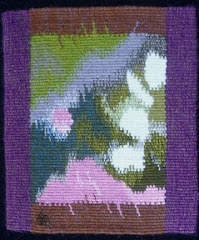
My tapestry is the latest in my Chaos series.

I have a hard time remembering which of the Chaotic Fragments are Parts 1,2,3 and 4, so I decided to give this one has its own name: “Turning From Chaos.”  It’s 10 x 10 inches.

Saturday, March 5, 2011

Tribute to James Koehler

TKoehlerwoolspurplehe first time I met James was a few years ago, at the Fiber Art Center in Amherst, where he spoke to TWiNE (Tapestry Weavers in New England). I had seen his amazing work of course, and knew how successful he was, so I was quite surprised to find him unassuming, friendly and kind.  His lecture was thought provoking and inspiring.

Last summer, after Convergence in Albuquerque, I went to St John’s College in Santa Fe, for the ATA retreat “Tapestry Enchantment,”  where I spent 3 days learning from James. I discovered that his reputation for being an incredibly generous teacher was well earned.

 KoehlerwoolsOn the first day, James talked to us about creating layers of image and/or meaning in our designs. I was working on sketches of Moon Snails, and once he realized I was drawing a complete blank, he suggested the word Moon!  Pretty obvious, but it had not occurred to me. My design process does not involve a lot of thinking, so after the initial excitement, I was still baffled as to how the moon could be incorporated into a design with the snail, and decided to forget it.

Moonsnaildesign That evening in my room, I decided to draw the shell again, only because my first drawing was too small. I felt my drawing needed more depth, and decided to draw the shadow. In one magical moment I realized: the shadow of my broken moon snail shell was a perfect waning moon! 

James invited all 32 of the retreat participants to visit his home and studio one evening. Here are a few photos from that visit. Koehlerstudio

Although he could be wickedly funny at times, this photo shows how seriously he listened when his students asked him questions. He told us that if we had questions later we could email him, and if he felt it required more than an email he would talk to us on the phone. He said that once we took his class we would be his students forever, and he was right about that. I’m sure none of his students will forget what they learned from him.Koehleryarns2

Seeing his luminous hand dyed yarns on the shelves, and his tapestries on the walls was inspiring. Everything about James was inspiring. I was  completely shocked to hear of his death. It is a huge loss for the many many people who were touched by this exceptional artist and man.

Perhaps the best tribute will be for his students to make an extra effort to live up to his example, in our art and in our lives.


Friday, March 4, 2011

Moon Snails All Over

Moonsnailcollection I have always loved Moon Snails. I find them on the beach at Cape Cod, and out on the flats at low tide. Usually they are broken, but sometimes not.

One day I brought home a handful of them, and was standing in the front yard chatting with a neighbor when I felt a tickling in my hand. A hermit crab had set up house in one of the shell fragments! So I had to carry him back to the beach.

MoonsnailfragmentSome of my shells are Sharks Eye, which are a type of Moon Snail. My favorites are the Northern Moon Snails, which are more colorful and have more dramatic spirals, like this one.

The spirals always go the same direction: clockwise from the center, when you look at the outside of the shell.

My brother, who reads a lot, tells me that there are rare snail shells that go counter clockwise, so I am on a lifelong quest for  the “widdershins” MoonsnailoilpaintingMoon Snail! (Did you ever wonder what they called it before the invention of the clock?)

I have been drawing and painting Moon Snails for about 30 years. This is an oil painting I did in graduate school, about 1981 I think!

 MoonsnaildesignLast summer I took a workshop with James Koehler, and he asked us each to bring along supporting materials for a concept or symbol of our choice. I brought Moon Snails.

This is the sketch I came up with for a small tapestry: a broken Moon Snail shell, with a shadow that is a perfect waning moon!

That was in July, and I have still not finished it. It’s being woven sideways, the left side in this photo will be the top of the tapestry. In other words, I will turn the tapestry clockwise when it’s done.

MoonsnailtapestryI got stuck on that thin yellow curve, and had to figure out a better way to do it. Now that I fixed that, I should be able to finish it pretty quickly, and I will….tomorrow…..or maybe the next day.

Meanwhile, my 2011 Sketch Diary is well on its way. Every day I draw in one of the squares. My rules are fairly simple.

Austin2011SketchDiaryPage1Rule #1 Sketch every day  #2 No going back to fix what I did the day before. #3 Don’t think too much or judge what I’ve done #4 Draw what I feel like drawing  #5 Work quickly.

I started page 1 with Moon Snails, thinking I would change the subject for page 2, but I ended up doing 3 pages of Moon Snails!  I just started page 4 and it is much more abstract. More about that later. Here is page 1. So many Moon Snails!

Austin2011SketchDiaryPage1